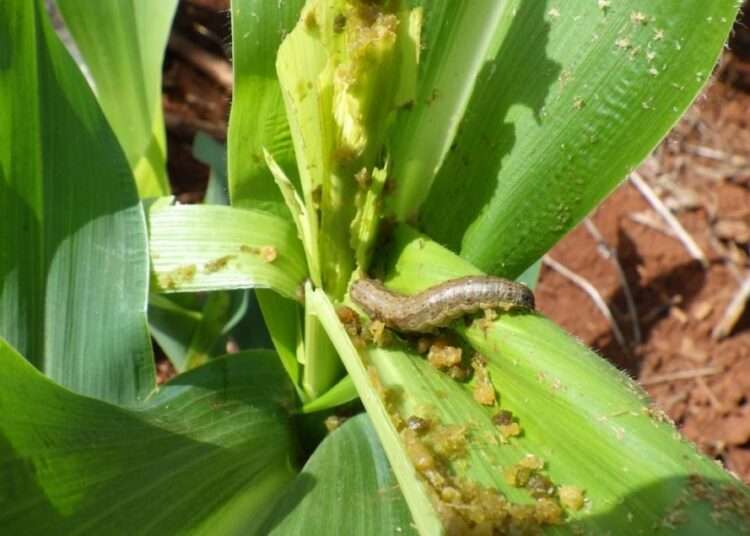
Researchers have disclosed that agroecology is the cheaper and safer alternative for managing potentially destructive pests, with the fall armyworm inclusive.
Under the agroecology project titled: “Developing Smallholder Strategies for Fall Armyworm (FAW) Management in Southern Africa: Examining the Effectiveness of Ecological Control Options,” funded by the Norwegian Agency for Development Cooperation in Zambia, researchers have conducted trials with 144 smallholders using soil treatments, carrying out experiments at two levels of soil management: conventional tillage; and minimum tillage and mulching (also known as conservation agriculture).
Further, the researchers explored three intercropping treatments: with no intercrop; intercropping with cowpea; intercropping with a locally selected legume. The aim is to build on strategies that smallholders are familiar with from their farming practices to ensure easy adaptation.
Natural methods can effectively control fall armyworm
The search to find a solution to the fall armyworm invasion that has been negatively impacting many people’s livelihoods is a concern shared by farmers, technical experts, private-sector organizations, and governments. All of them are determined to find a solution that will control the pest effectively and cost less and increase populations of natural enemies that feed on fall armyworm.
Since it arrived in Africa in 2016 from the Americas, the fall armyworm has adversely affected millions of farmers, attacking their fields and leaving a trail of damaged crops. Unlike many other pests, the fall armyworm is not easily controlled with synthetic chemical pesticides owing to its behavior of hiding in the leaf whorl. Fortunately, the researchers revealed that natural methods could effectively control it.
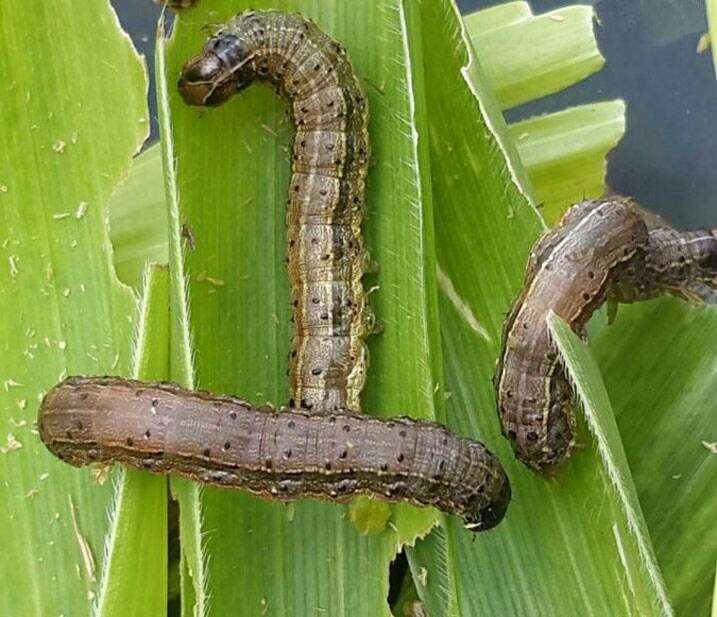
A doctoral candidate at the University of Zambia, Mutibo Chijikwa, one of the researchers, said natural enemies of fall armyworm include parasitoids, which are promising to help many smallholders successfully manage the pest.
“The data coming from the impact of various natural enemies, such as assassin bugs and earwigs, in fields are showing significant effectiveness in controlling fall armyworm,” she said.
“Our goal is to collect as much data as possible and propose valid recommendations to policymakers on fall armyworm management in Zambia and the world at large.”
Mutibo Chijikwa
Evelyn Phiri, a 59-year-old farmer in Kanakatapa Village, Zambia, where World Agroforestry (ICRAF) is conducting a 5-year project on the use of agroecology in managing fall armyworm, said, “the legume intercrop is helping to improve the soil for my crops while also giving me a source of relish. Most importantly, I no longer buy pesticides because we observe insects feeding on the fall armyworm”.
Intercrops such as cowpeas and beans, according to Demian Mabote of the Zambia Agriculture Research Institute, provide a crucial function in housing tiny organisms that help manage pests like the fall armyworm.
“The intercrop treatment is beneficial because it provides farmers with a pesticide-free harvest and improves their soil by adding nitrogen and minerals needed for healthy crops without using chemicals,” he said.
In a recent policy recommendation to the Government of Zambia, ICRAF’s Rhett Harrison, a tropical forest ecologist, conservation biologist, and project leader, urged the Government to invest in long-term strategies to effectively and sustainably manage the pest.
“The Government through the Ministry of Agriculture can focus on long-term sustainable approaches to fall armyworm management through integrated pest management,” he said.
“We cannot continue using pesticides as a first step in managing this pest. Numerous studies indicate that management of fall armyworms that prioritizes pesticides is neither effective nor sustainable. The synthetic insecticide is costly for most smallholders and carries serious risks to human health and the environment. Many pesticides are also not effective against fall armyworms due to their resistance and behavior of hiding in the leaf whorl. Most importantly, the over-use of pesticides negatively impacts natural enemies, such as parasitoids, ants, earwigs, wasps, spiders, and other insect-eating arthropods, which prey on fall armyworms and can significantly reduce infestation levels in fields. By overusing synthetic pesticides, we risk seriously damaging this important ecosystem service.”
Rhett Harrison
Using Nature to benefit farming
Agroecology is an approach that uses nature to benefit farming by employing nature-based practices, such as sustainable soil management and agroforestry, which help reduce pest damage to crops by increasing the health of plants and the abundance of natural enemies of the pest, enhancing pollination by providing habitat and resources for pollinators and reducing the need for synthetic fertilizers through use of organic fertilizers and better soil management. The advantages of agroecology include cheaper and more environmentally friendly ways of managing crop pests with cross-benefits for resilience.
Researchers argue that agroecological practices can better manage the fall armyworm in Sub-Saharan Africa, where farmers can ill-afford purchasing pesticides whenever their crops are attacked.
READ ALSO: Ghana: Mining Companies Mull Cost Inflation Risks to Operations