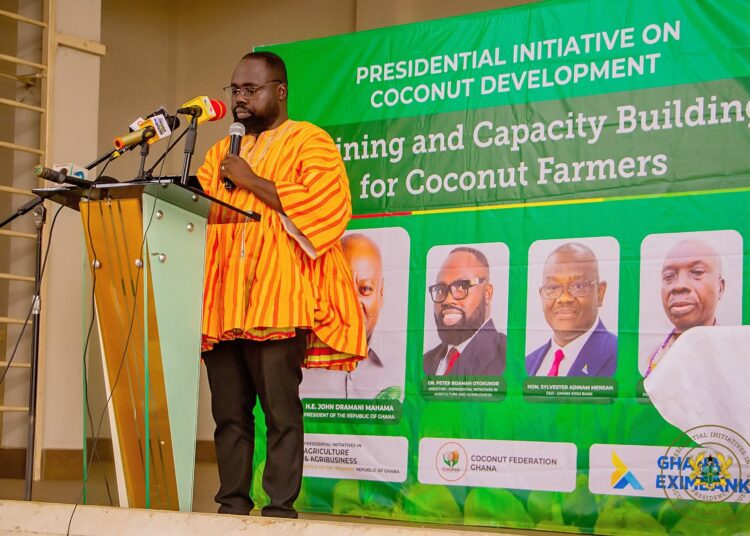
Ghana’s quest to dominate the global coconut market has entered a critical phase with the launch of an intensive nationwide capacity-building exercise. The Presidential Initiatives in Agriculture and Agribusiness (PIAA), led by Dr. Peter Boamah Otokunor, officially kicked off the first leg of its training program at the Prempeh Assembly Hall in Kumasi.
The initiative is a coordinated effort to transform the coconut value chain into a high-earning export powerhouse, moving the industry beyond the sale of raw nuts and toward sophisticated agro-industrialization.
“The training is geared towards empowering farmers with the technical expertise required to successfully nurture the coconut seedlings, ultimately boosting their productivity and yields. We have brought together experts with a deep understanding of coconut farming to share their knowledge and skills with you”
Dr. Peter Boamah Otokunor, Director of Presidential Initiatives in Agriculture and Agribusiness
The session brought together approximately 500 coconut farmers and agricultural officers from the Ashanti and Western North regions and served as the precursor to a larger rollout that will eventually span 11 regions across the country.
Funded by Ghana Exim Bank (GEXIM), the program is a strategic collaboration between the Coconut Federation-Ghana (COCOFEG) and the Federation of Associations of Ghanaian Exporters (FAGE).
While Ghana is already recognized as Africa’s top coconut producer and ranked 12th globally, the government is aiming for a massive scale-up. The state has already distributed 3 million improved seedlings to roughly 2,000 farmers, with an ultimate target of supplying 10 million seedlings.

However, officials recognize that seedlings alone do not guarantee a harvest; the success of the project hinges on the technical competence of the farmers on the ground.
Dr. Otokunor, the Director of PIAA, emphasized that the training is the “software” needed to power the “hardware” of the distributed seedlings. By providing farmers with specialized knowledge in pest management, soil health, and modern harvesting techniques, the government intends to secure its investment.
He noted that the success of this first phase is the primary prerequisite for the government to unlock a second phase of capital investment for the sector.
Doubling the National Acreage
The government’s ambitions for the sector are quantified by aggressive expansion targets. According to the PIAA Director, the current roadmap aims to double Ghana’s coconut plantation footprint from its current 90,000 acres to 180,000 acres by 2028.
This expansion is designed to provide the raw materials necessary to feed the burgeoning local processing industry, which produces high-value derivatives such as coconut oil, milk, and activated carbon.
“The mandate of GHANA EXIMBANK is two-fold: to help improve Ghana’s exports while reducing the country’s import value. That is why this initiative is important. EXIMBANK would have supported the setting up of many factories to add value to the coconut you’ll produce by the third year”
Dr. Peter Boamah Otokunor, Director of Presidential Initiatives in Agriculture and Agribusiness

Mr. Isaac Obeng Antwi, Deputy Project Manager of GEXIM Bank, reaffirmed that the bank’s support extends beyond the farmgate. The strategy is to ensure that by the time these newly planted trees reach maturity in three years, the infrastructure for value addition – factories and processing plants – is already operational.
This integrated approach ensures that farmers are not left with a surplus of raw nuts that they cannot sell or process.
Securing Markets Through Certification
One of the most innovative aspects of the training program is the introduction of a certification system.
Dr. Otokunor revealed that upon completion of the training, farmers will be awarded certificates that serve as a “seal of quality.” These certificates will be mandatory for farmers to participate in off-taker agreements, where the government facilitates contracts with industrial buyers who have committed to purchasing the produce.
Raman Taminu, Project Manager of COCOFEG, highlighted that this systematic approach prevents the waste of public resources and ensures that only the most dedicated and skilled farmers receive the full backing of the state.
By professionalizing the workforce, Ghana is positioning itself to be the primary supplier for international markets under agreements like AGOA and the AfCFTA.
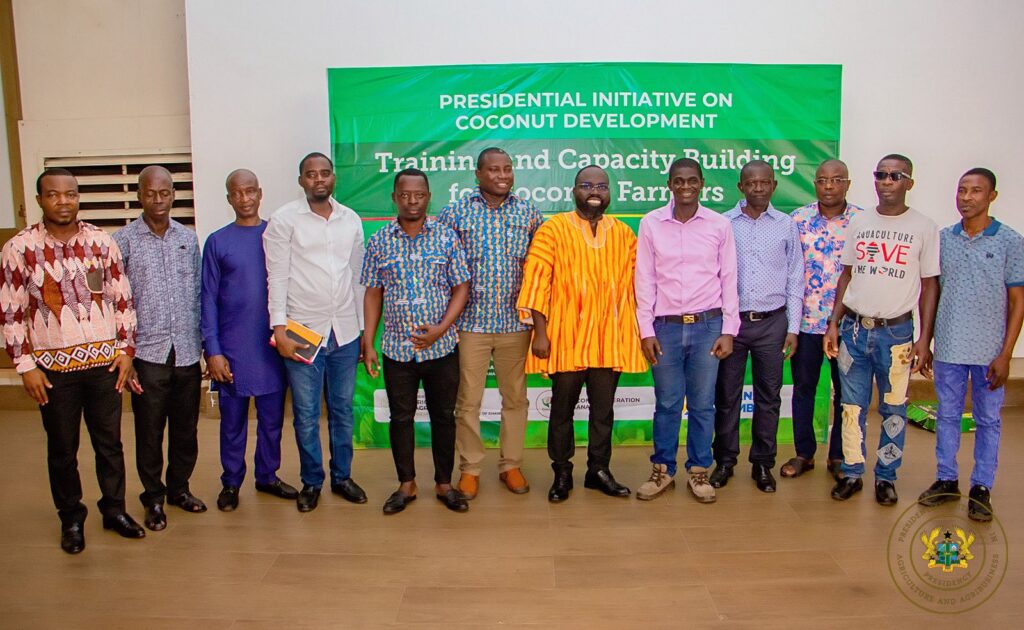
As the training sessions roll out across the remaining nine regions, the focus remains on job creation and rural empowerment. By diversifying the export base away from traditional commodities like cocoa and gold, the coconut initiative is creating a new “Green Gold” economy.
For the farmers in Kumasi, the message was clear: the knowledge gained at the Prempeh Assembly Hall is the first step toward a more prosperous, industrialized agricultural future.
READ ALSO: Represent Ghana’s Interest, Champion Reset Agenda – Mahama Tasks New Envoys