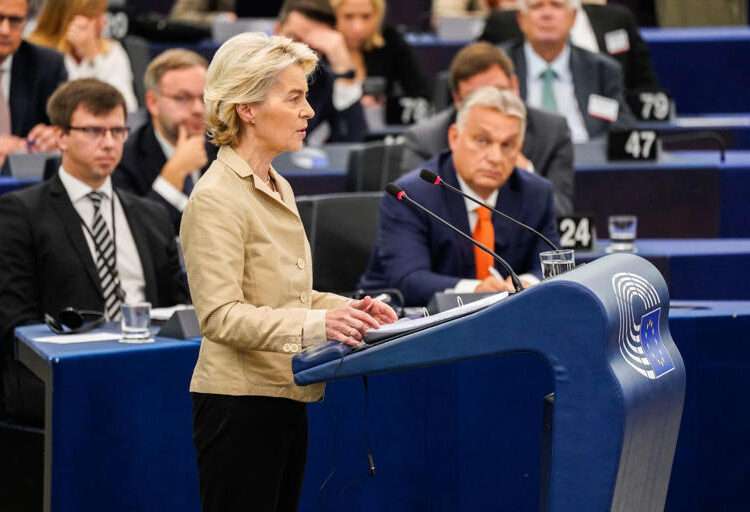
The European Parliament has voted to approve a trade deal between the European Union and the United States but with amendments added to protect European interests should the US fail to hold up its end of the bargain.
The deal was negotiated last July in Turnberry, Scotland, by US President Donald Trump and European Commission President Ursula von der Leyen, outlined in a joint statement published in August, 2025.
It set a 15% tariff on most goods in an effort to stave off far higher import duties on both sides that might have sent shock waves through economies around the globe.
New language now says that the deal can be suspended if it is determined that Washington “undermined the objectives of the deal, discriminated against EU economic operators, threatened member states’ territorial integrity, foreign and defence policies, or engaged in economic coercion.”
Bernd Lange, a German lawmaker and Head of the EU’s parliamentary trade committee, disclosed that, that clause was forged because of tensions over Greenland.
Trump drew widespread condemnation across the 27-nation bloc by threatening to take control of Greenland, a semi-autonomous territory of Denmark. He has backed away from the threat, at least for now.
Lange said at a news conference after lawmakers voted, “If this would happen again, then immediately the tariffs would be installed.” He said that the the protective modifications were “weatherproofing” the Turnberry deal.
He also noted that with the vote, “we have a strong mandate for negotiations with the Council and we intend to make the most of it.” He added that Members of the European Parliament will only be able to sign up to the trade terms of the deal if the regulation contains very strong and clear safeguards, and only after the US has fully respected the terms of the deal. “I intend to defend this mandate firmly in the negotiations,” he added.
“The conditions are clearly defined in Parliament’s position. They include a sunrise clause requiring full US compliance before the regulation can take effect, and a sunset clause ensuring full parliamentary oversight of any extension of the concessions, all the while remaining WTO-compliant. Any further tariff threat, or the failure of the deal to deliver for EU producers and consumers, will lead to the expiry of the legislation.”
Bernd Lange
There were formally two votes to introduce clauses to the deal. One passed 417-154 and the other 437-144 with dozens of abstentions each.
The two legislative acts were adopted by 417 votes in favour and 154 against, with 71 abstentions (adjustment of customs duties and opening of tariff quotas for the import of certain goods originating in the US); and 437 votes in favour and 144 against, with 60 abstentions (non-application of customs duties on imports of certain goods). MEPs are now ready to start negotiations with EU governments on the final shape of the legislation.
The US Ambassador to the EU, Andrew Puzder said that the vote would provide “stability and predictability” for US and EU businesses and drive economic growth. “We encourage all parties to think to the future and the importance of unleashing opportunities for businesses on both sides of the Atlantic,” he said.
Malte Lohan, CEO of the American Chamber of Commerce to the European Union, said that the vote is “the right signal for businesses that have been stuck in limbo over the past year” and “a necessary step towards a more predictable transatlantic marketplace.”
The EU had paused the deal in the wake of the February ruling of the US Supreme Court that struck down Trump’s use of an emergency powers law to set new import taxes.
The European Commission, the EU executive charged with trade negotiations, had sought clarity on the ramifications of the court ruling.
Croatian lawmaker Željana Zovko noted that despite the trade spat between Brussels and Washington, trade across the Atlantic had grown over the past year. “This resilience proves the trans-Atlantic trade works, and if it works, we should strengthen it, not hold it back,” Zovko said.
Deal To Be Further Negotiated EU Trade Representative And US Counterpart
The deal will now be further negotiated by EU trade representative Maroš Šefčovič and his U.S. counterpart Jamieson Greer, who are meeting on Friday on the sidelines of the World Trade Organization meeting in Yaoundé, Cameroon.
Šefčovič said after the vote in Brussels, “We need the EU-US deal in force on both sides — delivering real certainty for EU businesses and showing that genuine partnership gets results.”
The value of EU-US trade in goods and services amounted to 1.7 trillion euros ($2 trillion) in 2024, or an average of 4.6 billion euros a day, according to EU statistics agency Eurostat.
Europe’s biggest exports to the US are pharmaceuticals, cars, aircraft, chemicals, medical instruments, and wine and spirits.
Among the biggest US exports to the bloc are professional and scientific services like payment systems and cloud infrastructure, oil and gas, pharmaceuticals, medical equipment, aerospace products and cars.
READ ALSO: Minority Flags E&P Participation in Damang Mine Bid, Cites Conflict of Interest