A new survey has indicated that the low voter turnout recorded during the Ayawaso East by-election 2026 was not driven by dissatisfaction with government performance, contrary to claims by some political analysts and commentators.
The findings were presented by renowned pollster and Executive Director of Global InfoAnalytics, Mussa Dankwa, who stated that perceptions of the likely outcome of the election and the timing of the vote during the Muslim holy month of Ramadan played a much larger role in shaping voter behaviour.
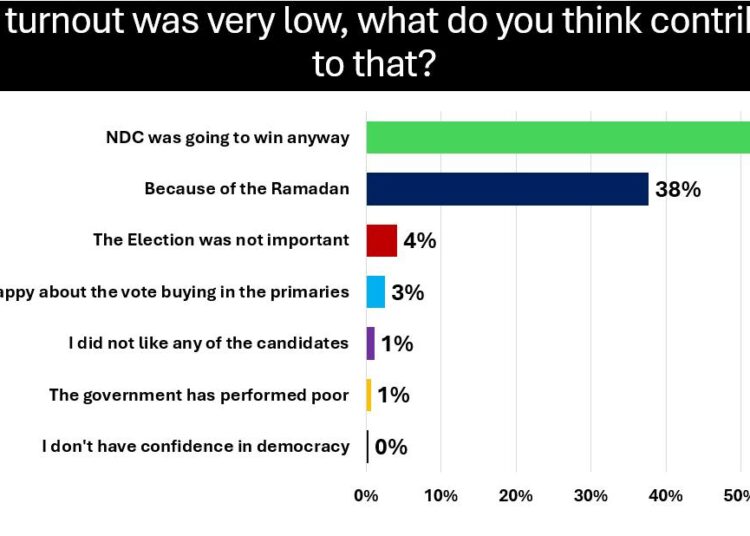
According to Mussa Dankwa, the survey showed that only one percent of respondents attributed their decision not to vote to dissatisfaction with the government’s performance.
“Low voter turnout in the recent Ayawaso East by-election was not caused by poor governance as suggested by some analysts and commentators,” Mussa Dankwa said while explaining the results of the study.
The survey instead found that most voters who stayed away from the polls did so because they believed the election outcome was already determined.
Perception of NDC Victory Discouraged Participation
The survey revealed that 54 percent of respondents said they did not vote because they believed the candidate of the National Democratic Congress would win the seat regardless of their participation. This widespread perception appears to have reduced the motivation for many voters to turn out on election day.
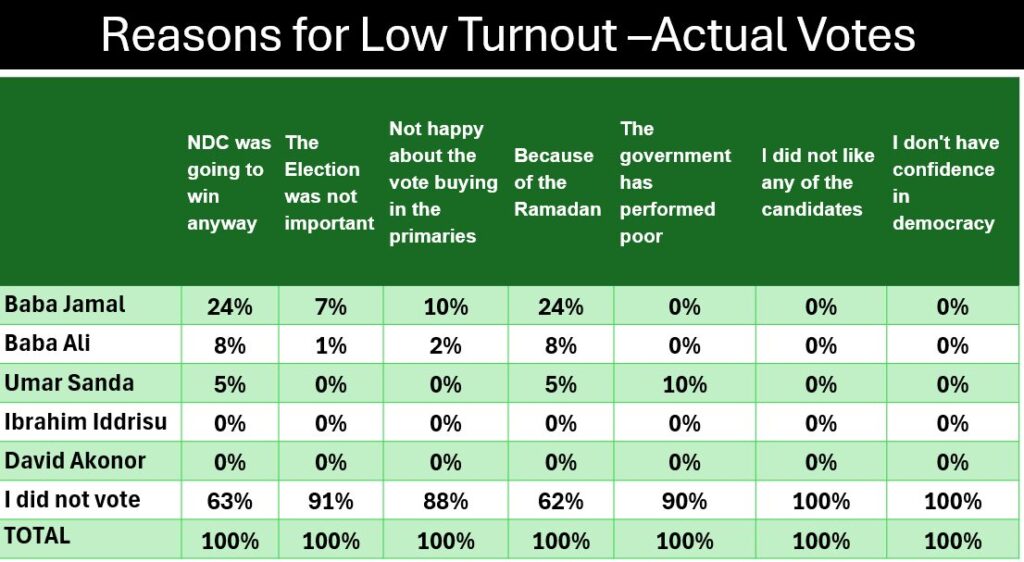
Among respondents who believed the NDC was certain to win, 63 percent said they did not vote. Within the same group, 24 percent reported that they voted for Baba Jamal, the NDC candidate who eventually won the election.
Eight percent of respondents in that category said they voted for Baba Ali Yussif of the New Patriotic Party, while five percent indicated that they supported independent candidate Mohammed Umaru Sanda. Mussa Dankwa explained that when voters strongly believe the outcome of an election is already decided, participation tends to decline.
Ramadan Also Influenced Turnout
The survey also identified Ramadan as another major factor that contributed to the lower turnout in the constituency. According to the analysis, 38 percent of respondents said the observance of the fasting period influenced their decision not to vote.
Within this group, 62 percent did not participate in the election. However, 24 percent said they voted for Baba Jamal, while eight percent supported Baba Ali Yussif and five percent voted for Mohammed Umaru Sanda.
The pollster noted that the timing of the election during Ramadan may have discouraged some voters in the constituency from participating, particularly in communities with significant Muslim populations.
Internal Party Concerns Also Affected Participation
The survey also examined whether developments within political parties may have influenced voter participation. Among respondents who said they were unhappy about alleged vote buying during the NDC primaries, a large majority chose not to vote in the by-election.
According to the data, 88 percent of respondents in that group did not vote. Only 10 percent voted for Baba Jamal while two percent supported Baba Ali Yussif.

Meanwhile, among respondents who said they did not vote because they were dissatisfied with the government’s performance, 90 percent still chose not to vote while 10 percent cast their ballots for Mohammed Umaru Sanda.
Mussa Dankwa said these results reinforce the conclusion that dissatisfaction with government performance was not a major driver of voter abstention in the election.
Voting Patterns Among Party Supporters
The survey also highlighted differences in participation among supporters of the major political parties. Among respondents who identified with the New Patriotic Party, 83 percent said they voted for Baba Ali Yussif, the party’s candidate. One percent said they voted for Mohammed Umaru Sanda, while 15 percent did not vote.
Participation among supporters of the National Democratic Congress was lower. Only 30 percent of NDC supporters said they voted for Baba Jamal. Two percent said they voted for Baba Ali Yussif while six percent supported Mohammed Umaru Sanda.
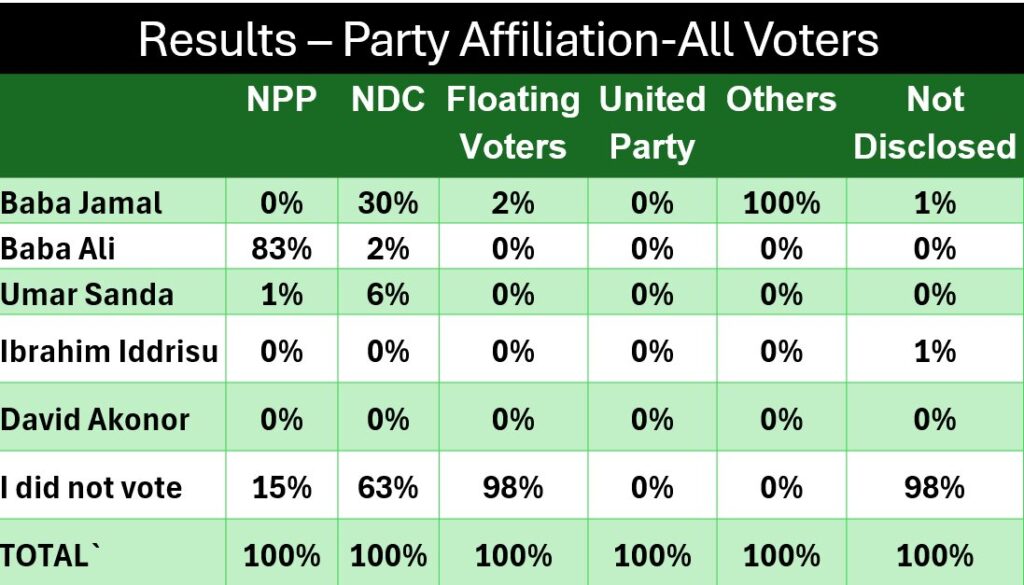
The remaining 63 percent of NDC supporters said they did not participate in the election. Floating voters recorded the lowest turnout. The survey showed that only two percent of respondents who identified as undecided voters participated in the election, and they all voted for Baba Jamal. The remaining 98 percent did not vote.
The by-election in Ayawaso East was held following the death of the constituency’s former Member of Parliament, Naser Toure Mahama. According to official results released by the Electoral Commission of Ghana, Baba Jamal won the election with 10,884 votes, representing about 63.8 percent of the valid votes cast.
His main challenger, Baba Ali Yussif of the New Patriotic Party, obtained 4,009 votes, representing about 23.5 percent of the total votes. Independent candidate Mohammed Umaru Sanda secured 1,885 votes, while the remaining candidates obtained smaller vote shares.
The election was conducted across 113 polling stations with 17,048 valid votes recorded. Out of a voter population of more than 49,000 registered voters, turnout stood at approximately 34 percent.
Following the declaration of results, Baba Jamal was sworn in as the Member of Parliament for Ayawaso East on March 10, 2026. Mussa Dankwa said the survey findings provide insights into the factors that influence voter behaviour and could inform strategies aimed at improving participation in future elections.
READ ALSO: 3.3% Inflation Strengthens BoG Rate Cut Case