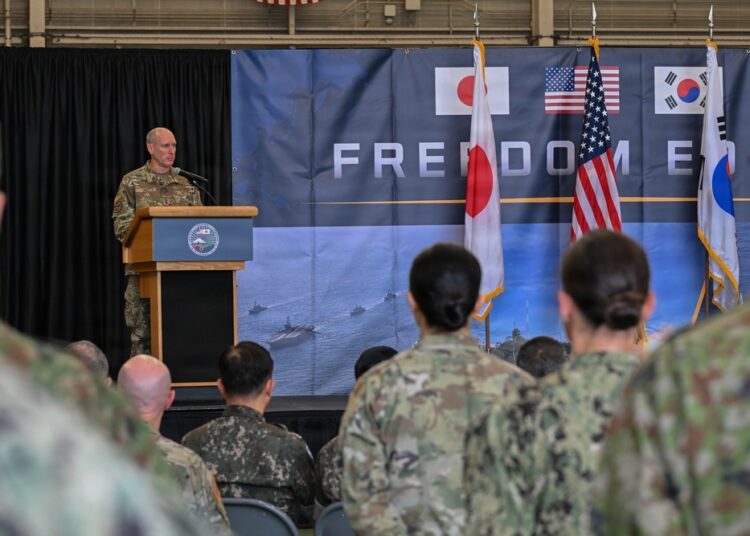
South Korea, Japan and the United States have begun a five-day joint military exercise in waters off South Korea’s southern Jeju Island, as the three allies seek to strengthen their ability to respond to North Korea’s nuclear and missile threats.
The Freedom Edge exercise began today and will run through Friday, bringing together major naval and aerial assets from the three countries. South Korea’s military said the drills are defensive in nature and are intended to improve the three countries’ ability to respond jointly to potential North Korean nuclear threats.
The exercise involves six warships, maritime patrol aircraft, fighter jets and aerial refuelling aircraft, according to South Korea’s Joint Chiefs of Staff. Among the South Korean vessels taking part are the country’s 7,600-ton Aegis-equipped destroyers, ROKS Seoae Ryu Seong-ryong and ROKS Yulgok Yi I.
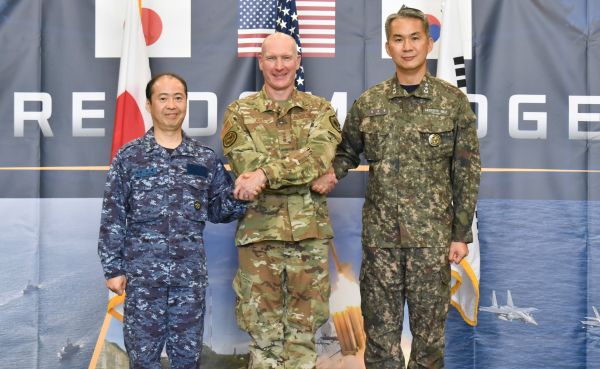
No US aircraft carrier is expected to participate, marking the second consecutive year without a carrier in the exercise. The three militaries will operate a joint exercise control group during the drills to coordinate the activities and ensure the exercise is conducted systematically and safely.
According to the Joint Chiefs, the exercise will strengthen operational coordination and joint response capabilities across multiple domains, including maritime, air and cyber operations. The drills are designed to improve interoperability among the three militaries, allowing them to coordinate more effectively in responding to security threats in the region.
Freedom Edge has been held annually since the United States, South Korea and Japan agreed at the 2023 Camp David summit to conduct regular multidomain military exercises. This year’s exercise is the fourth edition of the drills and comes amid continued tensions over North Korea’s advancing nuclear and missile programmes.
The latest exercises also follow a recent US-South Korean military drill that was unexpectedly shortened, highlighting the complicated balance between Washington’s efforts to maintain military readiness with its allies and President Donald Trump’s attempts to improve relations with North Korean leader Kim Jong Un.
The three countries have continued to strengthen their security cooperation in response to North Korea’s weapons development, while Pyongyang has consistently condemned their joint military exercises as rehearsals for an invasion.
North Korea Condemns Allied Military Drills
The latest Freedom Edge exercise has drawn criticism from North Korea, which views military cooperation between the United States, South Korea and Japan as a direct security threat.
Last week, North Korea’s Foreign Ministry accused Washington of taking a more confrontational approach towards Pyongyang, pointing specifically to the Freedom Edge exercise and reported comments from US officials reaffirming Washington’s commitment to the complete denuclearisation of North Korea.
The drills come less than three weeks after the United States and South Korea ended their annual Ulchi Freedom Shield exercise six days earlier than initially scheduled. The exercise, which had been planned to run from August 17 to August 27, ended on August 21 after Trump said he had ordered the Pentagon to “substantially reduce” the drills.
Trump cited what he described as a good relationship with Kim Jong Un, while North Korea has long regarded the US-South Korean exercises as preparations for an attack. However, the reduction in the US-South Korean exercise did not lead to a corresponding easing of North Korean criticism.
Kim Jong Un’s sister and senior North Korean official, Kim Yo Jong, dismissed the move, arguing that shortening the exercise did not change what she described as its “provocative, aggressive nature.” North Korea subsequently launched about 10 short-range ballistic missiles towards the sea, apparently following through on an earlier warning that it would respond to the US-South Korean military drills.
The latest Freedom Edge exercise is therefore taking place against a backdrop of heightened military tensions, despite Washington’s parallel efforts to maintain dialogue with Pyongyang. For the United States, South Korea and Japan, the drills provide an opportunity to improve coordination between their armed forces and prepare for potential threats involving North Korea’s increasingly sophisticated nuclear and missile capabilities. For Pyongyang, however, the exercise reinforces its longstanding concerns about the military posture of the three countries.
The five-day drills are expected to test the allies’ ability to operate across maritime, aerial and cyber domains while demonstrating their continued security cooperation in the region. As the exercise continues through Friday, North Korea’s response is likely to remain closely watched, particularly given its recent missile launches and repeated warnings against joint military activities by the United States and its regional allies.
READ ALSO: North Korea Commissions New Warship