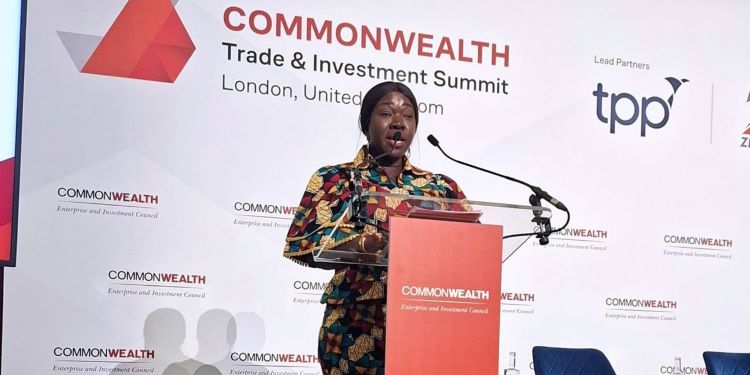
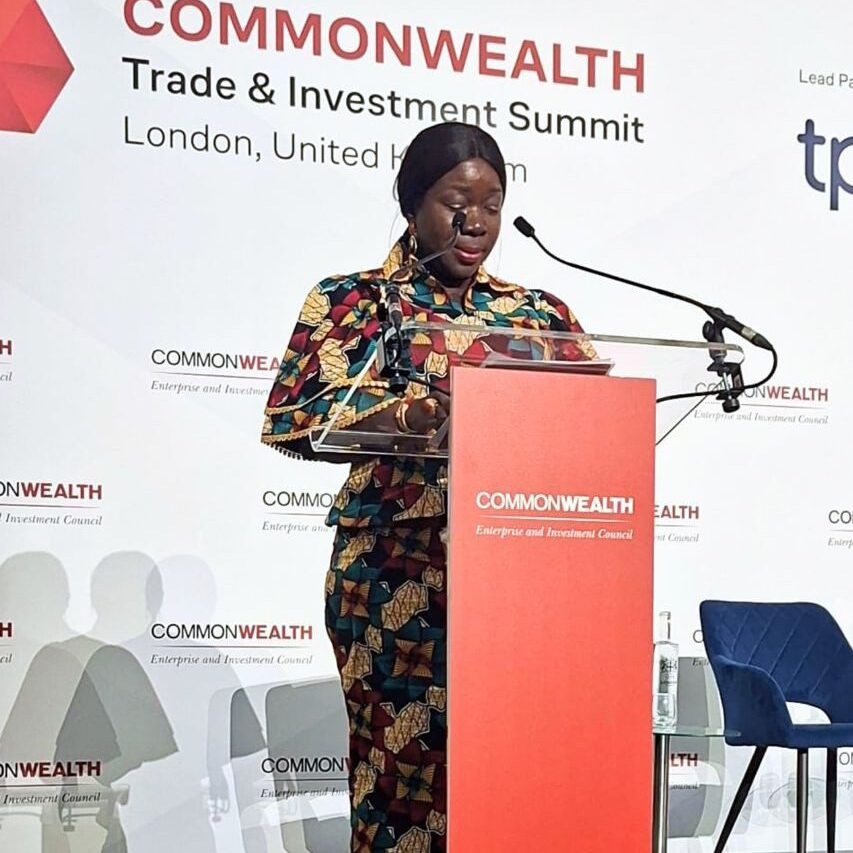
Ghana’s Minister for Trade, Agribusiness and Industry, Hon. Elizabeth Ofosu-Adjare, has delivered a high-stakes address signaling the end of the “raw material era” and the dawn of a sophisticated, value-added industrial economy at the Commonwealth Enterprise and Investment Council (CWEIC) Business Forum.
Speaking to the global investment community gathered in London for the event, on the theme “Africa’s Next Chapter: Building Resilient, Diversified Economies,” the Minister moved beyond diplomatic pleasantries to offer an expert, data-driven roadmap for how Ghana intends to dominate the continent’s next chapter of growth.
“The Minister emphasized that Ghana is at the forefront of this transformation, pursuing deliberate policies aimed at shifting from raw material exports to value addition and industrialization.
“She cited ongoing efforts to process at least 50% of Ghana’s cocoa locally and plans to expand gold refining capacity as part of a broader strategy to retain value within the economy”
Ministry of Trade, Agribusiness and Industry
According to the Ministry of Trade, Agribusiness and Industry (MoTAI), Hon. Ofosu-Adjare made it clear that for a long time, the “African growth story” was often synonymous with the extraction and export of raw commodities – a model that left the continent vulnerable to global price shocks and deprived of the secondary wealth generated by processing.
She announced that today Ghana is aggressively rewriting this script, as the central pillar of her address focused on the nation’s commitment to value addition, specifically targeting the country’s two most iconic exports: cocoa and gold.
Though the pledge to process at least 50% of Ghana’s cocoa locally is a massive industrial undertaking, Hon. Ofosu-Adjare explained that Ghana is fundamentally altering its GDP composition by moving from the export of raw beans to the domestic production of cocoa liquor, butter, and finished confectionery.
Similarly, she noted that the expansion of gold-refining capacity is to ensure that the “golden child” of West Africa retains a larger share of the value chain, shifting from a primary producer to a sophisticated mineral hub. This is the industrial move required to build a resilient economy that can withstand the volatility of the London or New York commodities desks.
The $5 Billion Milestone
While strategic plans are common in political rhetoric, the Minister backed her address with hard metrics. The revelation that Ghana’s non-traditional exports (NTEs) reached a record US$5 billion in 2025 is the strongest evidence yet that the diversification strategy is working, and she did not hesitate to use it.
The Trade Minister clarified that these NTEs are largely comprised of processed and semi-processed goods, representing a significant departure from the commodity dependence of the past. For Ghana, this $5 billion figure is not just a statistical win; it is proof of concept for global investors.
It demonstrates that Ghana’s manufacturing and agribusiness sectors are reaching the scale and quality required for international markets. The Minister noted that this surge is the primary driver behind the country’s current “upward trajectory,” as it provides a stable inflow of foreign exchange that is less susceptible to the boom-and-bust cycles of raw oil or gold prices.
Hon. Ofosu-Adjare used the London stage to highlight the Ghana Investment Promotion Authority Bill – a critical legislative reform designed to enhance the “ease of doing business.”
She noted that high-level investment requires more than just opportunity; it requires regulatory certainty – and the GIPA Bill introduces concrete incentives and strengthens investor protections, creating a business-friendly moat that distinguishes Ghana from its regional peers.

According to the Minister, modernizing the legal framework is the government’s signal to the Commonwealth that it understands the mechanics of global capital. She emphasized that these reforms are part of a broader effort to provide a stable, predictable environment where capital can be deployed with confidence.
Perhaps the most compelling part of the Minister’s pitch was Ghana’s geopolitical positioning. As the host of the African Continental Free Trade Area (AfCFTA) Secretariat, Ghana is no longer just a market of 33 million people, but the administrative and logistical gateway to a unified market of 1.4 billion people.
Hon. Ofosu-Adjare framed Ghana’s stable democratic governance and its strategic location as the entry point for any investor looking to tap into the continent’s vast potential. This situating of the AfCFTA hub in Accra positioned Ghana as the regulatory capital of African trade at the conference.
The “gateway status” was highlighted as a unique strategic advantage that allows investors to use Ghana as a launchpad for duty-free, quota-free access to the entire continent.
Macroeconomic Fluctuations
Addressing the “elephant in the room” – the macroeconomic fluctuations of the previous years – the Trade Minister was candid but optimistic, pointing to a “strengthened external position” and “significant fiscal consolidation,” as signs that the Ghanaian economy has successfully turned the corner.
Declining inflation and sustained economic growth were cited as indicators that the “hard work of the past 24 months is beginning to yield results.”
Through acknowledging the challenges and presenting the data of the recovery, the Minister offered a realistic and grounded invitation to partnership, with the upcoming Ghana-UK Investment Summit presented as the immediate next step for those ready to capitalize on this momentum.

The address by Hon. Elizabeth Ofosu-Adjare at the CWEIC Business Forum was a masterclass in economic diplomacy, as it moved the conversation beyond the potential of Africa and into the execution of Ghana.
It focused on value addition in cocoa and gold, proved the success of the NTE sector, and solidified the legal framework through the GIPA Bill to highlight Ghana’s mature and industrializing economy.
READ ALSO: MIIF Boss Highlights Institutional Reforms to Strengthen Governance