
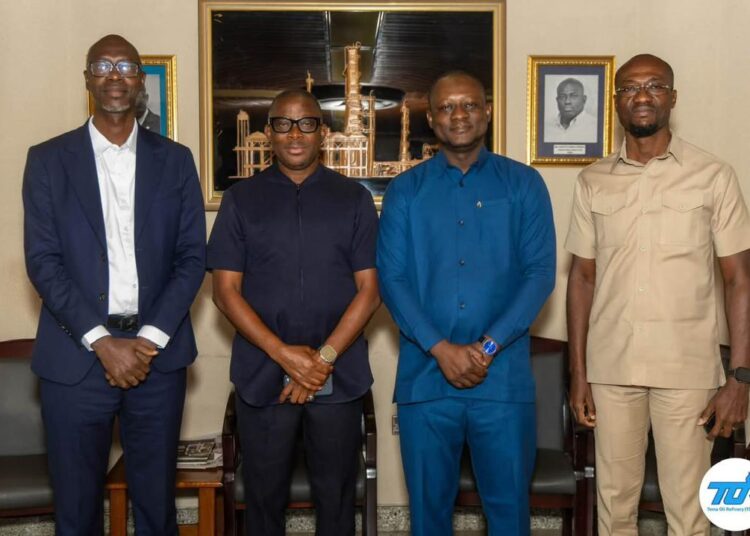
The Tema Oil Refinery (TOR) has held high-level discussions with the Ghana Oil Company Limited (GOIL) to strengthen collaboration between the two state-linked petroleum institutions, with the meeting focused on improving petroleum products supply security, market resilience and price stability for consumers.
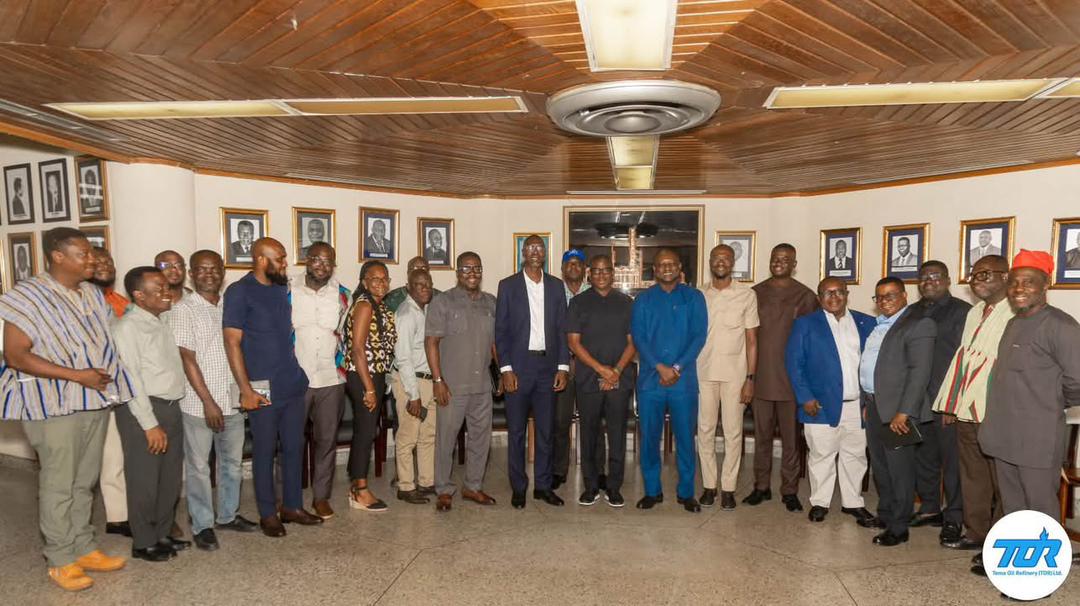
The engagement, held at TOR, brought together GOIL Group Chief Executive Officer Edward Abambire Bawa and members of his Executive Management Team.
The discussions form part of efforts to build stronger coordination across Ghana’s downstream petroleum sector at a time when fluctuations in international oil prices, supply conditions and domestic operating costs continue to influence prices at the pump.
The meeting is significant because TOR and GOIL occupy different but complementary positions within Ghana’s petroleum value chain.
While TOR’s refining capacity provides a potential domestic source of refined petroleum products, GOIL operates extensively within the downstream market, giving the company direct exposure to fuel distribution, retail demand and consumer price pressures.
Strengthening Cooperation Across The Downstream Value Chain
The discussions centred on how both institutions can deepen strategic cooperation to improve the reliability of petroleum product supplies and strengthen the downstream market against disruptions.
For Ghana, supply security is closely connected to the country’s exposure to international petroleum markets.
Although domestic refining can reduce some dependence on imported finished products, crude feedstock, refining economics, foreign exchange movements and other market conditions continue to influence the cost of petroleum products.
A stronger relationship between a domestic refinery and a major downstream oil marketing company could therefore improve coordination between refining, product availability and market distribution.
“Our engagement focused on strengthening and deepening the strategic collaboration between TOR and GOIL as we work together to enhance petroleum products supply security, strengthen market resilience, and contribute to greater price stability at the pump for the Ghanaian consumer.”
Tema Oil Refinery
The emphasis on price stability is particularly important for Ghana’s wider economy.
Petroleum prices influence transportation costs, logistics, industrial production and the cost of goods and services. Sustained increases in fuel prices can therefore transmit inflationary pressure well beyond the filling station.
Consequently, measures that improve supply efficiency and reduce avoidable market disruptions can have economic benefits extending beyond the petroleum sector itself.
Market Resilience Becomes Increasingly Important
The meeting comes against a broader backdrop of volatility in global energy markets.
Ghana’s downstream petroleum market remains sensitive to international crude prices and refined-product prices, while movements in the cedi-dollar exchange rate can also affect the local cost of imported petroleum products.

Recent calls from stakeholders for government to review taxes and levies on petroleum products have further highlighted the pressure facing consumers and transport operators.
The Ghana Private Road Transport Union has also warned that rising fuel and other operating costs could make existing transport fares increasingly difficult to maintain.
Against that backdrop, supply-side cooperation between TOR and GOIL could become an important component of a broader strategy to strengthen the downstream market.
The strategic value of the partnership, however, will ultimately depend on whether the discussions translate into operational improvements.
Collaboration alone does not guarantee lower pump prices. The impact would need to emerge through more reliable product availability, improved utilisation of domestic refining capacity where commercially viable, better supply planning and greater efficiency across the value chain.
That distinction matters because petroleum price formation involves several variables beyond the control of individual companies.
TOR Positions Partnership Around National Energy Security
TOR has framed the engagement as part of its broader commitment to Ghana’s energy security and the national interest.
The refinery has historically occupied a strategic position in Ghana’s energy system because domestic refining capacity provides an alternative to complete reliance on imported finished petroleum products.
Maximising the value of that capacity, where technically and economically feasible, can potentially strengthen resilience during periods of international supply disruption.

GOIL, meanwhile, provides an important downstream link between petroleum suppliers and consumers.
Deeper institutional cooperation could therefore create opportunities to better connect domestic refining activity with market requirements.
“The partnership between our two institutions is critical to building a more efficient, reliable and resilient downstream petroleum sector.”
Tema Oil Refinery
The statement reflects a wider policy question facing Ghana’s petroleum industry: how can existing national assets and commercial operators work together to reduce vulnerabilities within the fuel supply chain?
The answer cannot rest solely on increasing refining capacity.
A resilient downstream system requires sufficient crude supply, financially sustainable refining operations, efficient storage and transportation infrastructure, reliable distribution networks and a market capable of absorbing refined products competitively.
The TOR-GOIL engagement therefore has significance beyond the immediate meeting.
It points towards a model in which stronger coordination among Ghanaian energy institutions could contribute to reducing supply risks and improving the functioning of the domestic petroleum market.
From Strategic Discussions To Measurable Outcomes
The institutions have indicated that the next step is to translate the discussions into concrete actions and sustainable outcomes.
That will be the critical measure of the partnership.
If cooperation results in better supply planning, more efficient utilisation of available refining capacity and stronger coordination between refinery output and downstream demand, the benefits could extend across the petroleum value chain.

Greater predictability in supply could also help businesses plan more effectively and reduce exposure to sudden disruptions.
For consumers, the most visible test will be whether stronger collaboration contributes to a more stable and reliable fuel market.
“At TOR, we remain committed to working with key industry stakeholders such as GOIL to support Ghana’s energy security and advance the broader national interest.”
Tema Oil Refinery
The engagement also reinforces the importance of domestic institutions working collectively as Ghana seeks to strengthen its energy security.
Rather than treating refining, fuel distribution and retail markets as separate components, closer coordination could help address weaknesses across the entire downstream chain.
For GOIL, deeper cooperation with TOR could also strengthen its position within a domestic petroleum ecosystem increasingly focused on resilience and supply security.
For TOR, collaboration with a major downstream market player provides an avenue to better understand and respond to market requirements.
The broader objective is therefore not simply a closer institutional relationship, but a more coordinated downstream petroleum system.
The meeting between TOR and GOIL comes at a time when Ghana’s energy policy is increasingly focused on reducing vulnerabilities, strengthening domestic capacity and protecting consumers from external energy shocks.
Turning the partnership into measurable improvements in supply reliability and market efficiency will determine whether the engagement delivers on that ambition.
READ ALSO: Burnham Faces Pressure Over Economic Direction at First PMQs